


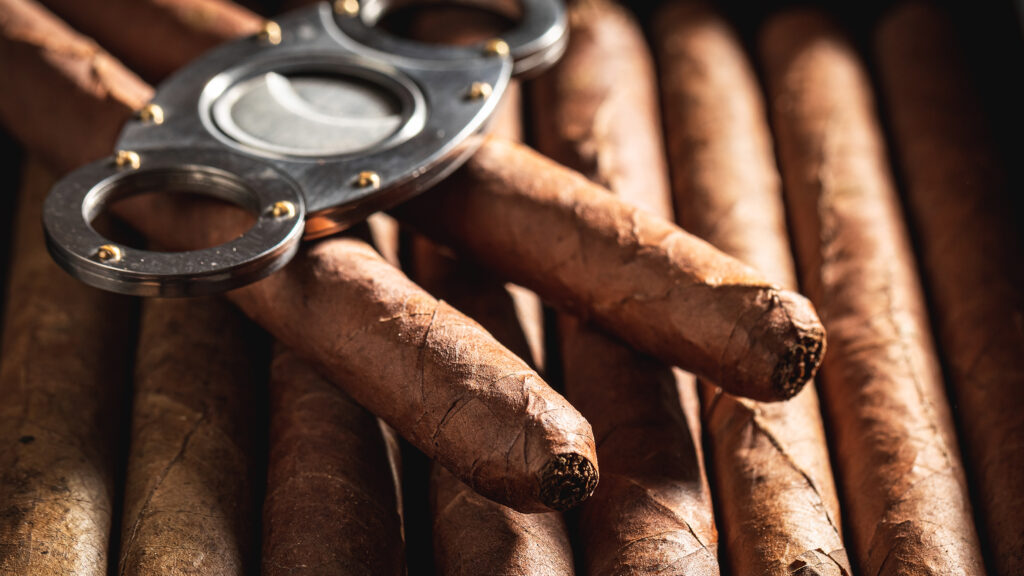
Two strains of tobacco, Rustica and Tabacum are native to North and South America. The former in North America and the latter in South America and the Caribbean. Most every culture cultivated it, even those who farmed nothing else.
October 29th – Columbus sails into the calm waters of Bahia de Gibara, Cuba (what he then called Hispaniola). He sends two Spaniards onto the island where they meet Taino “Indians” who are smoking huge “cigars” – tobacco leaves wrapped in corn husks.
Jean Nicot, French ambassador to Portugal was so profligate in spreading the new world leaf that its pre-imminent chemical component – nicotine – is named for him.
Thomas Hariot, a servant to Sir Walter Raleigh in his “Brief and True Report of the New Found Land of Virginia” referring to the tobacco growing wild writes that “There is an herb called uppowoc, which sows itself.”
England is so enamored of tobacco that the highest quality Spanish tobacco sells for $125 a pound in today’s dollars.
Spanish King decrees tobacco may be grown only in specific colonies, including Cuba, Puerto Rico, Santo Domingo and Venezuela. Direct sale of tobacco to foreigners is punishable by death.
Londoners spend £320,000 a year on tobacco. £120,000 of which still ends up in the hands of the Spanish. The Portuguese and Dutch also cash in on England’s addiction. The English need more colonies in the new world so they too can grow tobacco for the mother country.
Explorers Hudson and Champlain discover NY state Iroquois growing tobacco in the Chemung Valley (near today’s Elmira).
William Strachey, the first secretary of Jamestown, describes two types of wild tobacco, varying in height from roughly two to eight feet. Planting of higher quality seed from the Caribbean tobacum seed begins as soon as seed can be smuggled or otherwise obtained.
The first cigar store figure reported in London. These symbols became necessary to inform a largely illiterate population that tobacco was available for purchase at their tavern, wine and ale house, apothecary, grocery, chandlery or tobacconist shop.
House of Commons in England votes unanimously “that the importation of Spanish tobacco is one of the causes of want of money within the kingdom.” England was undergoing a severe coin shortage, and would soon ban importation other than from their New World colonies.
Spanish King again rules that Cuban tobacco can be sold only to Spain. The edict creates a job opportunity for smugglers for the next 181 years. Tobacco farmers, vegueros, rebel against the edict.
Growing tobacco was prohibited throughout France; capital punishment could be imposed.
By this time cigar smoking was all the rage in Spain and the Royal Manufacturers of Seville was founded to consolidate the industry.
In Maryland, tobacco was legal tender for all salaries and debts, including those owed the government, at the rate of 1¢ per pound.
Tobacco first planted as a cash crop in the Dominican Republic. A century later it was one of two largest cash crops, mostly exported to German principalities.
Dutch traders who were responsible for a great deal of commerce around the globe brought the cigar back to Holland and, meandering their way to Russia found an cigar enthusiast in Catherine the Great who had her Cigars adorned with dainty swaths of silk to shield her regal fingers from the taint of tobacco.
Virginia passes the Option Act making it possible to pay the clergy in money instead of tobacco.
New Seville cigar factory finally finished, the largest industrial complex in the world, a “walled city” with more than 4,000 daytime inhabitants with its own chapel, rules and prison. Its workforce rolled 100,000 cigars a day. Similar factories would later be established by the Spanish Crown in Mexico and the Philippines.
The irrepressible Israel Putnam, “Old Put” as he would be called, brought back “three donkey loads” of Cuban Cigars to Connecticut following the British invasion of the Caribbean Island. It is believed that he had stashed some seeds for planting in the fertile Connecticut Valley as well. It is to him that we likely owe our enormous gratitude for the great Connecticut tobacco we enjoy today.
Spanish King re-enacts ban on selling Cuban tobacco or cigars to foreign powers. After the brief British take-over of Havana in 1762, the ban was reestablished in 1764.
England captures Havana for nine months, during which more international shipping went through Cuba than in two and a half centuries of Spanish control. The entire world got introduced to Cuban tobacco, exotic hardwoods, and fruits. Spain got Cuba back by treaty but learned that once a pleasure is known to the world, it is very difficult to hide or control.
The British occupation of Cuba lasted less than a year (It was given back to Spain as part of the Treaty of Paris which ended the French and Indian War (The Seven Years War as it was known to the rest of the world), but it was long enough for Cuba’s “golden weed” to find its way to the non-Spanish parts of Europe.
British Lt. Col. Israel Putnam returned to his farm in CT from occupation of Havana. He brought cigar tobacco seed and more than 30,000 cigars. How much seed? No one knows, but tobacco is one of the world’s tiniest seeds. Enough to plant 500 acres will fit inside a lipstick tube. It takes 300,000 of these dust-size seeds to weigh an ounce).
Spanish King re-establishes ban on selling Cuban tobacco or cigars to foreign powers.
Cigar smoking begins to catch on in New England and major North American port cities. Cigars were cheap and almost entirely home made “paste cigars” so called because wrapper was glued to keep it from unwrapping. These were generally rolled by farm wives. Cigars were sold by their husbands or traded to local merchants or Yankee wagon peddlers.
US colonies declare independence from England. Tobacco growers were in perpetual debt to British merchants. Taxes were heavy. Tobacco helped finance the Revolution by serving as collateral for French loans.
Cigars are being imported into Boston from the West Indies (Cuba and Jamaica).
Napoleon Bonaparte of France invades Spain and his pillaging soldiers stumble upon Cuban cigars for the first time.
Less than a decade later France, like Spain sets up a structure to try to monopolize the lucrative trade.
The first cigar factory in America is built in Suffield, Connecticut by Roswell and Samuel Viets. The enterprise is so successful that by 1830, production exceeded some 14 million cigars annually.
Join the Liberty Cigar Guild for exclusive content and to be the first to learn about our latest product launches, limited edition drops, and all things Liberty Cigars!