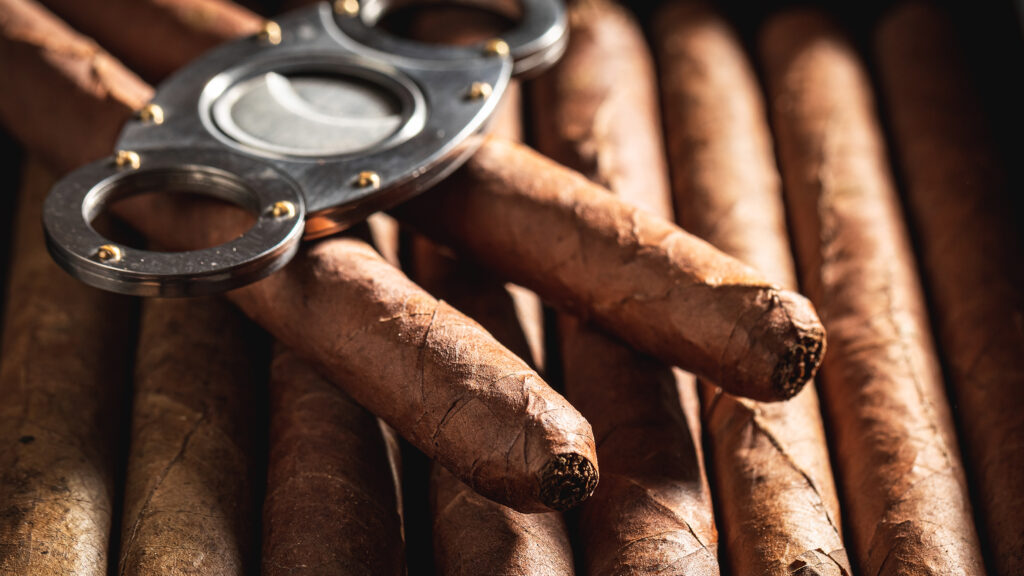
The origin and timeline of these fascinating sticks

Learn About Our Cigars & The Stories Behind Them

The Online Journal of The American History Guild & Its Companies

Our newsletter for exclusive updates and news

Why We Do What We Do

The Lounge

Techniques, tips, & etiquette

Select a decade

1850s

1850s

Scroll the Years

1850

The last great legislative battle among the three most politically powerful Senators, John C. Calhoun, Daniel Webster, and Henry Clay resulted in “The Compromise of 1850,” barely stalling secession and possibly war, for ten more years.

Vice-President Millard Fillmore became President upon the untimely death of Zachery Taylor.

1851

Great American classic novel Moby Dick by Herman Melville published in serial form.

1852

Blockbuster novel Uncle Tom’s Cabin published by Harriet Beecher Stowe, daughter of anti-slavery preacher Lyman Beecher and sister of seven preachers including abolitionist Henry Ward Beecher and wife of anti-slavery college professor Calvin Stowe. The book was banned in the South but inflamed anti-slavery passions in the North.

1853

Franklin Pierce inaugurated as 14th President with the party slogan of “We Polked them in ’44, We’ll Pierce them in 52.”

1854

Congress passed the Kansas-Nebraska Bill applying the principle of “popular sovereignty” to the creation of new states. The unpopular measure led immediately to the creation of the Republican Party, a coalition of Northern Whigs, Free Soil Party, abolitionists, and others.

1855

Ambassador James Gadsden closed the deal with Mexico for another 30,000 square miles to round out the acquisition from the Mexican War.

1856

James Buchanan, “Old Buck,” won the Presidency for the Democrats over the upstart Republican Party, which did remarkably well with the “The Pathfinder,” John C. Fremont.

Bloody civil war raged in Kansas between pro and anti-slavery settlers.

Congressman Preston Brooks of South Carolina beat Senator Charles Sumner of Massachusetts half to death over a public insult to Brooks’ uncle, Senator Butler. Brooks resigned and was accorded a hero’s welcome at home. Sumner recovered to become the foremost Northern leader of Reconstruction after the Civil War. Pro and anti-slavery passions heated to red-hot over the incident.

Abolitionist John Brown and his gang massacre five settlers in Pottawatomie, Kansas.

1857

The Supreme Court in the Dred Scott vs. Sanford decision declared that slaves were not citizens and could not sue in federal court and, therefore, Scott had to remain enslaved though he lived in free territory for a number of years. 

1858

Abraham Lincoln delivered his “House Divided” speech in Springfield, Illinois after accepting the Republican nomination to run for Senate against Stephen A. Douglas the “Little Giant” of the United States Senate.

1859

Abolitionist leader and wanted murderer John Brown raided Harpers Ferry, Virginia with his gang in a failed attempt to raise a slave rebellion. After barricading themselves in the fire engine house, the raiders are attacked by a platoon of Marines who kill or capture most of the gang. Brown was charged with treason and hanged by the state of Virginia.

Not Clickable

The origin and timeline of these fascinating sticks

Learn About Our Cigars & The Stories Behind Them

The Online Journal of The American History Guild & Its Companies

Our newsletter for exclusive updates and news

Why We Do What We Do

The Lounge

Techniques, tips, & etiquette

The Liberty Cigar Guild

Join the Liberty Cigar Guild for exclusive content and to be the first to learn about our latest product launches, limited edition drops, and all things Liberty Cigars!

By clicking Subscribe, I agree that the Liberty Cigar Company may, upon occasion, send me emails or texts with exclusive products, news, information about events, or special promotions.

Opt-out at any time by using the unsubscribe mechanism provided in all of our communications.

We will never sell your private information, ever! Please read our Privacy Policy within our Terms & Conditions for more information.